Custom Piggyback Labels
A label that moves with your information. Plan custom piggyback labels with a removable top label that can be reapplied to a form, record, or another package.
Discuss your project →
What are piggyback labels?
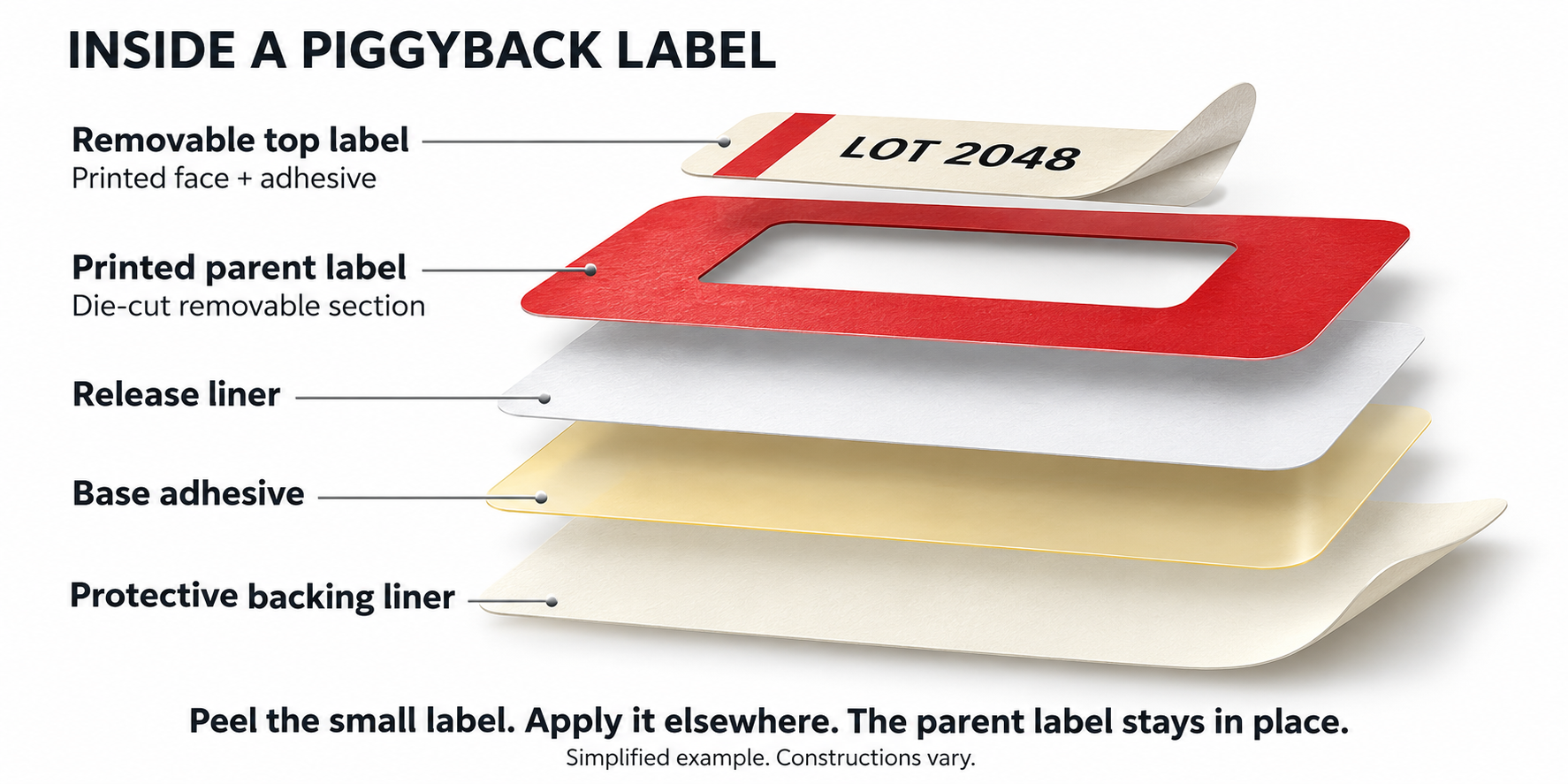
Piggyback labels place one self-adhesive label over another. After the complete label is applied to a package, the top label can be lifted off and attached to a second surface. The base label stays on the original package. This transfer step is what makes the construction useful when product information, an identifier, or a promotion needs to travel elsewhere.
How the layers work
The top label has its own adhesive so it can be removed and attached somewhere else. A release surface between the layers lets it separate from the base. The base has another adhesive layer to hold it on the first surface, and a bottom liner protects that adhesive before application. Material and layer combinations vary; confirm the proposed construction against your actual surfaces and application method.
Two destinations, one coordinated label
Start by identifying where each part belongs. The base might stay on a carton while the top label moves to a registration form or inventory record. A promotional label might transfer from the package to a reply card. Decide which information must remain on the product and which information needs to move before designing the artwork.
Peel-off coupons and promotions
A removable coupon can travel from a product or mailer to a reply card, redemption form, or another surface while the base stays behind. Plan the coupon artwork, the information that remains visible, and how the customer will redeem the offer. If a promotion reveals information underneath, specify both the reveal and the need to reapply the detached label. A reveal-only label does not necessarily have the same transfer function.
From the package to the device
A small flavor or strain identifier can stay with a device after its outer package is set aside. Jetty Extracts documents this approach on its own packaging: the customer removes the small identification sticker and attaches it to the device. This illustrates the transfer function rather than a label that only opens to reveal information. For your project, specify the size of the removable strip, the surrounding parent label, the device surface, and the information that needs to remain on each part.

Inventory, samples, and product records
A matching identifier on the package and the transferable label can connect an item with its accompanying record. Before printing, map where each label will go and which code or text must appear on each layer. If several removable sections are needed, provide a drawing showing their sizes and intended destinations so the team can review the layout.
Specify both surfaces and both adhesive requirements
A piggyback construction has two adhesive layers with different jobs. The lower layer attaches the base to the original package; the upper label must release from that base and then attach to its final destination. Share the materials of both surfaces, how long the label will remain in place, and any handling or storage conditions. Ask our team to confirm an appropriate construction for the actual project.
Piggyback, peel-and-reveal, or booklet labels?
Choose by the action you need the label to perform. A piggyback label transfers a self-adhesive top label to another surface. A peel-and-reveal label opens to expose more information on the package. A booklet label carries folded or multiple printed pages. Names can overlap between suppliers, so a physical sample or a clear description of the opening and transfer sequence is a useful starting point.
Prepare artwork for the base and the removable top
Show the complete label dimensions and the dimensions of the removable area. Identify the copy, branding, or identifiers needed on each printed surface. If the label will carry a barcode or QR code, provide the approved data and intended scanning workflow. Keep any critical information away from areas used to lift the top label, and have the final layout reviewed against the proposed construction.
What to send for a custom piggyback-label quote
- An existing label sample, drawing, or photograph showing how the top label should transfer
- The original package surface and the surface receiving the removable top label
- Overall label size, removable-label size, and artwork for each printed surface
- Quantity per design and expected reorder requirements
- Hand or machine application, plus existing roll direction, core, and roll-size specifications
- Any numbering or variable-data requirements for the team to assess
- Delivery ZIP code, required date, and relevant storage or handling conditions
Review the complete transfer before production
Evaluate a working sample on both intended surfaces. Check that the top lifts as expected, the base stays in place, and the transferred label adheres at its destination. Review legibility and any scannable identifiers after transfer, as well as the application method. Confirm material availability, quantities, proofing steps, and the production schedule with Pacer for the specific job.
Frequently asked questions
Are piggyback labels the same as removable labels?
A removable label describes how a label releases from a surface. Piggyback describes a layered construction with a top label that can be transferred while a base remains behind. Specify both the construction and the adhesive behavior you need.
Can I keep information on the package after the top label is removed?
That is a key reason to consider a piggyback construction. Identify the information that must remain visible on the base, and confirm the printed surfaces and final layout during the project review.
Can piggyback labels include barcodes or sequential numbers?
Include the intended data, numbering sequence, and scanning requirements in your inquiry. Our team will review the printing and verification requirements for your job before confirming the specification.
What is the minimum order or turnaround time?
The answer depends on dimensions, materials, printing, artwork versions, quantity, and finishing. Send your specifications so the team can confirm the quotation and schedule.
Ready to plan the next run?
Send your current sample or artwork, quantities, and delivery requirements. Pacer Packaging is based in Simi Valley, California. Include your delivery ZIP code so our team can review the project and shipping requirements.
Request a packaging quote →